Blog Feed

My First Blog Post

You only get one first blog post…. right?

So don’t mss it up!

My name is Deron. I currently reside outside Twinsburg. I grew up in the suburbs of Detroit and moved to Cleveland with my wife (of now 22 years) in 2000 after law school. In addition to the two of us, we have two daughters and a dog that is far too spoiled for her own good.

I am coming to education as a second career. My first was practicing law and I eventually reached a point where I decided a change would be good… so I went and did the thing I always thought I’d do if I could do it over again – teach high school math. As a lawyer, I always thought the best part was talking with clients. My kids are nearly grown, which makes transitioning a bit easier. One is at OSU (which kinda kills me since I graduated from that school up north). The other is a high-school sophomore.

I learn best by doing and by puzzling the pieces together into a picture that makes orderly sense. I don’t do abstract learning particularly well (at least I don’t think so), so I’m always trying to find analogies that will help we relate abstract ideas to tangible ones.

I’m not sure I entirely know what is meant by taking intellectual risks. If it means risking time, energy and resources to investigate a new intellectual area that may not pay off, then I think I need only have confidence that someone who knows better than me will tell me when I am/have barked up the wrong tree for too long. If, on the other hand, it means taking the risk of offering a contrary viewpoint, then I only need the confidence that “good faith” is governing the conversation. With creative risk… allow me the time and tools and then be gentle in pointing out the design flaws.

I will admit that most of my reading has been in algebra and geometry textbooks lately, but I read a number of very thought provoking articles in Dr. Reynolds ED452 literacy class. One in particular- “Reading Mathematics: More than Words Can Say” by T. L. Adams – was a great reflection on the nature of mathematics as language, and how math has characteristics that are very common to other languages but is also subject to misunderstandings and misinterpretations. (The Reading Teacher, Vol. 56, No. 8 (May, 2003), pp. 786-795)

This, and other articles, have led me to think much more deeply about learning math as a literacy concept rather than just a content or logic matter. I am beginning to see where students are misinterpreting the language of math rather than failing in its processes or logic.

As for questions: Dr. Shutkin, what protocols do (or would) you follow in maintaining personal/professional social media profiles/blogs as an educator?

Distributed Cognition in the classroom

Were I to define “distributed cognition” as I understand it from class discussion and readings, it is a concept that emphasizes capturing the full scope of knowledge resources and knowledge distribution tools that are contained in a learning environment with the objective of developing lessons that optimize the the resources in a cooperative and intentional manner (pedagogy) to enhance learning opportunities for all students.  Stated another way, distributed cognition considers learning and knowledge “organism-ly” (where the organism is the whole learning environment) rather than individually (as student and teacher). At its core, distributed cognition pushes against the common picture of the teacher as the primary/exclusive source of knowledge and capability in the classroom – instead encapsulating all of the learning tools that are in the environment, including those that reach outside of the immediate environment. 

The robustness of this conceptual approach to the learning environment and learning system results from the many tributaries that feed it – including considerations of technology (what is available, what does it do, what is it capable of doing), the role of technology (how will it fit in with pedagogy and content, what tasks will it assume, how will the it add to the environment or detract from it, how will it affect the student or teacher), the nature and characteristics of the learner (what do they already know, what experiences do they have), the content being presented, the pedagogical techniques that are available, etc. 

Peter McIntosh, a high school, remedial algebra teacher in an urban California district, exemplifies one embodiment of distributed cognition as depicted in the Edutopia.org video entitled “Blended Learning Energizes High School Math Students”  McIntosh makes extensive use of an online education platform (Khan Academy) to deliver content to his students and, in significant part, to define the nature of teacher-student and student-student engagement in the classroom.

Key to the success of the program is the technology available to students – namely, computers with which to connect to the Khan Academy classroom, the Khan platform itself, which is intensely scaffolded, offering videos and hints to help students succeed, the classroom white board on which McIntosh can show a model example problem for reference, paper and pencil that students use to work out problems in a way the computers don’t readily afford.  The computer is essential to connecting students to the information and tools available on the Khan Academy platform. Interestingly, though the computer serves this function, it seems to simultaneously limit the connection between students, who all appear to be working independently.

Unseen to the student, but central to success, are the monitoring functions that the Khan platform includes.  This affordance allows McIntosh to monitor all of his students in great detail and to identify areas and concepts where specific students are struggling and where groups are struggling.  This affords McIntosh the ability to implement a very self-paced model of learning.  The monitoring capability built into McIntosh’s chosen technology is one of the four key pedagogical functions performed by technology. (Martin 2012).

Another of the key pedagogical functions performed by technology involves offloading. One of the features of the Khan platform is that McIntosh is able to offload a significant portion of content delivery and focus on one-on-one and small group, tailored instruction.  Even aspects of this one-on-one support are offloaded to Khan academy as McIntosh expects students to use the videos and hints that Khan provides (and then, their fellow students) before accessing the teacher.  This ability to offload (and essentially distribute) aspects of the teacher’s cognitive load to an external resource enables McIntosh to focus and adapt his pedagogical practices towards a more individualized classroom structure.  I note that the students are not grouped together in McIntosh’s classroom.

In some respects, the Khan platform generates a significant effect with technology.  (Salomon and Perkins 2005). The platform expands on McIntosh’s ability to self-pace lessons for his students and his ability to differentiate instruction by directing his attention to those students who need help after processing the videos and hints.  There is also a significant effect of technology.  Students are engaging the Khan platform to such an extent that its removal would likely upend student learning.  McIntosh observed near the beginning of the video that many of the students had bad habits.  It is very likely that the habits students are now developing are tightly integrated with the Khan platform and the method of content delivery it provides.

McIntosh weaves technology and pedagogy together in a way that demonstrates results in improved student learning.  It is apparent that he has considered the technology available, its role in the classroom and pedagogical structure, his students abilities and capabilities and the content all in creating an environment in which students are working effectively toward math mastery.

Martin, L. (2012). Connection, Translation, Off-Loading, and Monitoring: A Framework for Characterizing the Pedagogical Functions of Educational Technologies.Technology, Knowledge & Learning17(3), 87-107.

Person. (2012, October 10). Blended Learning Energizes High School Math Students (Tech2Learn Series). Retrieved April 23, 2020, from https://www.edutopia.org/video/blended-learning-energizes-high-school-math-students-tech2learn-series

Salomon, G. & Perkins, D. (2005) “Do Technologies Make Us Smarter? Intellectual Amplification With, Of and Through Technology.”In: Robert Sternberg and David Preiss (Eds.). Intelligence and Technology: The Impact of Tools on the Nature and Development of Human Abilities. Mahwah, NJ : Lawrence Erlbaum and Associates, Publishers. pp. 71-86.

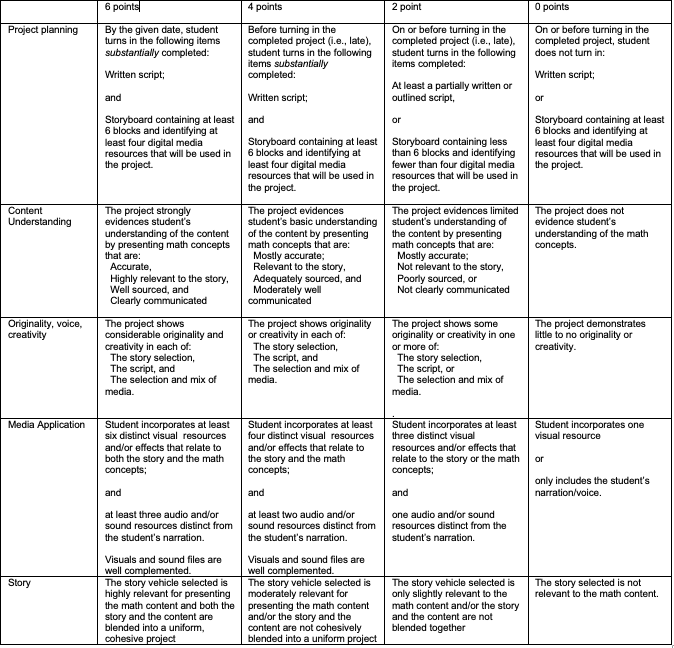
Digital Media Rubric

Rubrics are an art and I have borrowed heavily from Ohler in identifying five areas, from Ohler’s “Digital Story Assessment Traits” that would be important to me in evaluating a digital media project. As Ohler suggests, I have built into the rubric a component directed to the planning phase of the project and its associated artifacts (script and storyboard). (Ohler 2013). Encouraging proper planning as part of the rubric is, in my view, a key way to help keep students on task and to prevent them from becoming overwhelmed.

Content understanding is a key representation (in my application) of math rigor. There are several ways to define content, but my focus is on the math content and less the story, since I would tolerate a completely fictional story provided the math was sound and the story was relevant to the content.

Since this is a media project, I have a section dedicated to the types and forms of media used in the project. The numbers of each type feel somewhat arbitrary and I can envision pushback from a student that wants to present a simple story. However, one aspect of the project is simply to practice weaving media types together into a unified whole, so I feel justified in my selections.

I believe in the age of the internet, originality and voice and important. It is too easy to cut and paste a storyline, but I think originality and creativity shine through. I am less concerned about “voice” – both because I don’t want to confuse my student into thinking I am referencing physical voice (like the narration) and because I think voice gets represented in and through creativity and originality. How students frame the work “speaks” to me about their voice.

Finally, the story matters so it is the last item in the rubric. The story needs to to blend two or more concepts in a way that makes them relevant to each other and brings math to life in a meaningful way or application.

Citation:

Ohler, J. (2013) Chapter 4: Assessing Digital Stories.  Digital Storytelling in the Classroom. Thousand Oaks, CA : Corwin. pp. 83-91.

Journal Entry- Technology Observations

Mayfield High School has a tremendous technology infrastructure, program, and focus, which is presently allowing the district to deliver educational content to students quarantined at home.  Information about the Mayfield district technology initiatives, hardware and software is readily available from the 7-member technology team, which is housed at the high school.  This team is headed by Technology Director John Duplay and Assistant Director Tony Jiannetti, both of whom are key contacts for understanding the technology goals and hardware/software needs of the district, as well as ensuring the infrastructure is in working order.  In addition, there is a large amount of information about the district’s technology programs available through the district website. 

Technology really infuses the high school.  Several years ago, Mayfield initiated the 1:1 initiative/mission to “create a collaborative learning environment through the utilization of district approved technology for all members of the educational community”. (See http://www.mayfieldschools.org/ChromebookPolicies.aspx). A key component of this initiative is to ensure each student has access to technology at home and in the classroom.  To this end, each high school student is given a Chromebook to access digital content and to interact with content and learning using digital tools and techniques.  The Chromebook (education edition) is distributed at the start of their high school career.  They are allowed to use it through the year (including summers) and upon graduation, the Chromebook becomes theirs to keep.   The Chromebooks are equipped with Google’s G-Suite for Education, as well as key content and school access programs, like Infinite Campus and Schoology.

There is a filtering program on the Chromebooks (Barracuda Chromebook Security Extension), and other access limits depend on whether the student is accessing the internet through the school’s Wi-Fi network or their own and time of day.  The district’s technology website notes that “Chromebooks can stream music, access Netflix, Facebook, Twitter and other social media sites but only after 3:30 p.m. on school days.”  (http://www.mayfieldschools.org/ChromebookPolicies.aspx). There are category restrictions as well, thus, websites and content related to Adult Content, Alcohol and Tobacco, Illegal Drugs, Pornography, Nudity, Violence and Terrorism, and Weapons are always restricted.

The district has elected not to install a monitoring program to track students’ activity on the Chromebook.  As an aside, this feature was introduced by Hudson High School this year, so I do receive a report of my daughter’s activity each week.  If a teacher needs to access restricted content, then there are processes to do so in cooperation with the Technology Department.  I know that in the classroom, I can unblock Youtube content on the teacher’s desktop at the push of a button.

Beyond simply getting Chromebooks to students, part of the technology mission of the district is to incorporate technology into the classrooms, using digital smartboards, which are available to all classrooms, along with document cameras, and mimeos.  One of the most technology laden areas is the new Option space for self-paced students.  The Option space is filled with large screen televisions that can be connected wirelessly to laptops and Ipads so that teachers can screencast from their personal devices.  The space is truly an “ode” to technology and the possibilities for technology in the school.  The library is another technology infused area, with approximately two-dozen desktop computers for students to use throughout the day. 

Beyond this, there are technology classes – specifically, Mayfield is a member school in the Excel TECC program and is the site for the Information Technology and Interactive Media programs headed by Ron Suchy and Mike Caldwell respectively.  These programs offer access and training on a wide variety of technology resources for digital media and IT including, without limitation, cameras, monitors, scanners, printers, editing software, etc. 

One particularly “neat” initiative is the Chromebook repair class.  This is a class offering that serves to help students learn how to repair computers.  Not only is this an excellent learning opportunity, but it provides an on-site location for students to receive help keeping their Chromebooks in good repair.  The first repair is free to students, which is a tremendously valuable benefit. Several of my students have used this program to fix their broken screens, keyboards, and/or track pads.  The idea of creating a class around computer repair to meet the needs of students is just one more example of the technology focus in the district. 

The sheer scope and range of technology resources at Mayfield High School is a testament to fulfilling the 1:1 initiative.

For further information, the following links provide significant additional information about Mayfield’s technology resources. As an aside, the website itself is a tremendous source of helpful links and resources, aside from being informative about the district. (See, e.g. http://www.mayfieldschools.org/techlinks.aspx) for a variety of useful digital tools and platforms)

http://www.mayfieldschools.org/InformationalTechnology.aspx

http://www.mayfieldschools.org/InformationTechnologyProgramming.aspx

http://www.mayfieldschools.org/InteractiveMedia.aspx

http://www.mayfieldschools.org/TechnologyDepartment.aspx

Digital Storyboard – Exponential Functions in the age of CV-19

This outlines a short digital media story that relates the concepts of functions and graphs (in this case, exponential functions) with real life scenarios. This sort of a project could be implemented in an algebra, algebra 2 or trigonometry class.

The scene opens in darkness with news reports about the coronavirus slowly getting louder and playing on top of each other… intense music plays softly in the background.

The reports and music fade to silence

“In the early months of 2020, the world fixated on one word – “Coronavirus”. 

A picture of the virus develops out of the darkness

“A novel form of this virus, first identified in late 2019 in Wuhan, China had, by February 2020 spread throughout the world; rapidly becoming a global pandemic and raising comparisons to the Spanish flu of 1918.”

“Within weeks of its first appearance in the United States, many communities, including the entire state of Ohio, began implementing unprecedented shutdowns and restrictions on travel, work, business, and schools.”

Question mark…. Starts small and increases in size

But why did we have this reaction?

Silence and darkness…

Change in music to something lighter light coming in….

“Well, to understand why such drastic measures were taken across the country, let’s look at some of the math surrounding the data and investigate what made this enemy so concerning. When Covid-19 first appeared in Wuhan China around December 2019, the number of cases in China was very small and seemed to grow slowly….. “

Dates and numbers of cases flash on the screen 1…6… 9… 12…

In a population of over 1 billion people, a handful of cases hardly seems like a problem at first.

Dates and number of cases continue to  flash on the screen (numbers growing rapidly)

 1/2122232425/2627282930
 2783105748351297/ 19852761453759977736
  +32+264261462/688776177614601739
Increasing numbers of cases…..

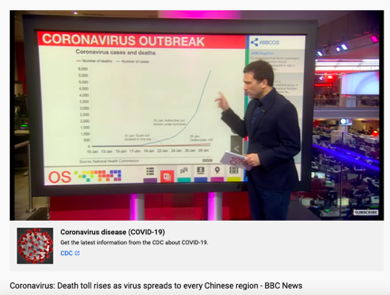
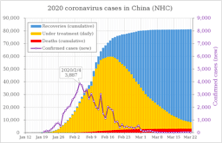
But within a few weeks, the number of new cases began increasing rapidly.  By February, the number of patients in China was growing by thousands daily…

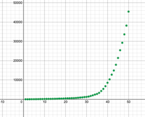
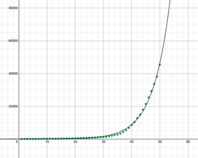
Shift to a Desmos graph showing data.

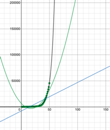
If we plot the daily number of cases on a graph, we can see a picture of how the virus was impacting the country….


https://www.desmos.com/calculator/6iti7tx05u

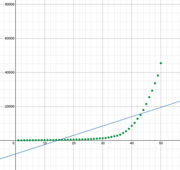
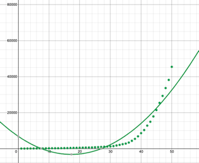
When we try to fit the best line for this data, it is apparent that linear and quadratic functions don’t work well. 

Insert linear and quadratic lines (desmos)

“Instead, this kind of graph is best represented using an exponential function”

exponential regression

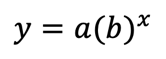
Take a look at the generic formula for exponential growth

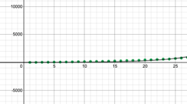
Applied to this scenario, a represents the number of cases at the start, x represents a number of time periods (that can be represented in hours, days, weeks, months or years) and b represents the common ratio or “multiplier”.  The common ratio is the key measure of growth in an exponential function. In exponential graphs, the values often start out very small and early growth can appear very low. 

focus in on the early part of an exponential graph….

That low growth early on hides what is coming…

expand outward and then focus on the bend…


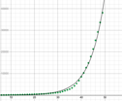
By extrapolating the graph out we see that there is a bend in the curve… a point at which the graph, or in this case, the number of patients with coronavirus, begins to grow very quickly…. More quickly than our linear or quadratic regressions would have predicted. The timing of that bend depends on the common ratio.


(graph to add linear and quadratic best fit lines)

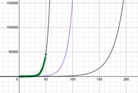
Given two exponential equations having the same starting point and running for the same period of time, we can see how changing the common ratio affects the curve. 


Graph is shown with different exponential functions…

Do you see how decreasing the common ratio … that is, decreasing the rate of new cases from 25% to 10% to 5%, changes the x-coordinate of the bend in the curve?  While the bend still takes place, it happens much later along the x-axis, which, in our example, means it happens much later in time. 

Early on, physicians and researchers realized that if steps were not taken to reduce the number  of new cases, the exponential function predicted an unprecedented burden on the nation’s healthcare system.  To buy time, to develop new treatments, to prepare our hospitals, to build community support, officials took unprecedented steps to reduce exposure, to limit the number of new infections, to reduce the common ratio and, ultimately, to stop the rise of new cases.

The good news is that while math and exponential functions can help explain data and make predictions, they don’t control our destiny.  The early story in China looked grim, but indications are that the measures they took are turning the tide.    

My perspective on student technology use and group dynamics.

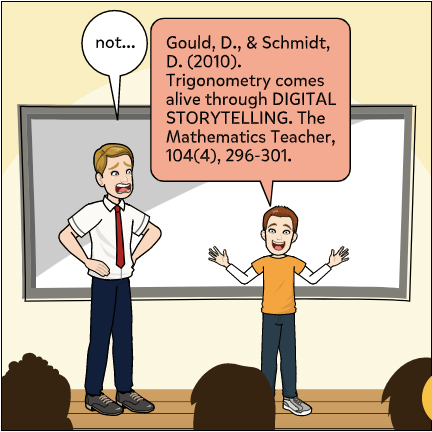
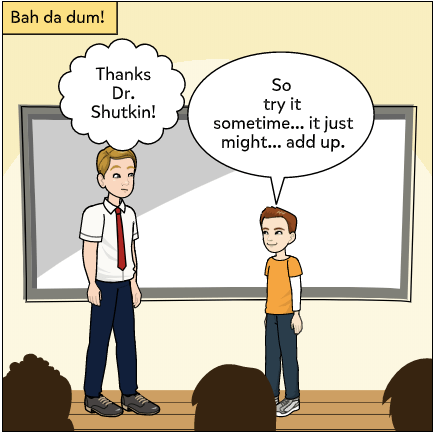
I have the privilege of teaching five classes of 10th grade students daily.  In this capacity, I have perspective both in creating opportunities for small group interaction and to observe how students interact organically, before and during class.  Small group dynamics in all of my classrooms are interesting.  In every class there are groups that congregate with each other, usually not more than 3 to 5 students per group.  Then, there are several who shun or are shunned by these groups and tend to work alone, even when grouped.  In one class last semester, a student e-mailed me to tell me that she wished not to be put into any group, because it caused her anxiety.  The existing dynamics are often very difficult to overcome.  I can force integration of different groupings, but that tends to negatively affect the “group” working environment and generate complaints.  Group dynamics would definitely be a factor to consider when assigning, for example, a collaborative digital project.  Beyond the personality preferences inherent in small group dynamics, there are matters of ability level and motivation to consider.  I wonder if a collaborative digital project is better left to self-selected groups – even though that might limit the number and variety of perspectives in the group.  Doug Gould did not specifically address this component of grouping in his co-authored article about incorporating digital media projects in his trigonometry class, mentioning only that the students worked in groups of two or three.  (Gould and Schmidt, 2010).  The implication seems to be that the groups were self-selected, thereby allowing groups to build stories around common experiences, like swimming.  If I were to institute a project, I think allowing students to gravitate around common experiences would motivate participation, and so I would be inclined toward allowing self-selection of groups.

I have both observed and asked students about their use of social media.  Tik Tok, Instagram and Snapchat are huge social media exchanges.  Students use their phones for music, videos (YouTube) and games.  Periodically, I invite students to use apps like Desmos.  Not shockingly, although there are blocks on Chromebooks, students have figured out a set of games they can play on them.   I often catch them, during breaks in content, playing Tetris or the like.  The students are very familiar using social media apps – which would be a benefit in implementing a digital media project.  Not only are students (largely) comfortable promoting themselves in digital media, but they are familiar with the process of taking, editing and uploading basic photos and video.  As this component (ie., using technology) of the project is one more familiar to my students than me, it would be fascinating to me to see how the students would use the digital media tools to create material or a project for class.

            Recently I had the students collaborate in a poster project for a test that was coming up.  The students really seemed to enjoy the project (notwithstanding some groups that struggled to meld together).  In the end, the feedback was positive.  I can definitely foresee incorporating digital components into a future project and suspect that it might be quite successful, if introduced in a somewhat limited and scaffolded manner.  One concern from Gould’s article is simply the amount of time he allocated for the project.  While the article mentioned 6 days in the lab, it also mentions days spent in project overview, brainstorming, and then refining ideas – even before entering the lab.  (Gould and Schmidt, 2010).  Right now, the content burdens and testing requirements are creating a crush at the end of the year.  I am not certain that a comprehensive digital project like Gould’s would fit into the existing curriculum, but a more tailored project certainly could.

Gould, D. and Schmidt, D. A. (2010). trigonometry comes alive through DIGITAL STORYTELLING. The Mathematics Teacher. 104(4). 296-301.

Euclidea pt. 3

As I continued to play with this game I realized a couple of new things. First, for another $0.99 I can unlock all the hints to the levels. That is a useful feature, though in most games, aren’t the hints free?

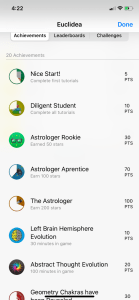
Second, there is a points system that tracks use of certain tools in the game and completion of levels. There is also a leaderboard (with 283,200 players), but after playing only a few days, I’m already in the top 100,000, which suggests the game is not widely played! I don’t think the leaderboard would be much of a motivation to students. Once you hit 500 stars, you cannot go any higher. Since the leader board is already filled with people who are at 500 stars, I don’t think new players can get to the top.

Third, the game is available on-line at https://www.euclidea.xyz/en/game/packs, which makes it accessible to students using chromebooks, laptops, desktops, and the like. I like the interface on the web version (and I prefer using a computer to play the levels). On the web version, all of the key tutorials are up-front, rather than distributed throughout the opening levels as in the app version. In some respects the ability to use the program on a computer makes it more likely that I would incorporate it into a lesson as a demonstration or challenge activity.

Euclidea pt.2

Having fussed and struggled my way through the first few levels of Euclidea for blog post 1, I decided on a reset and went back to the beginning. The second time around was not only a bit more “fun” but also more beneficial. The first time through, I was just interested in passing levels. I finally gave up and paid the small fee to open everything (which I’m glad I did… keep reading). This new time around I focused more on the challenge of beating the levels within the “allowable” moves. I was much more comfortable with the process of playing and could focus more on the objectives specifically.

This reflection makes me think the game would benefit from a low-stakes tutorial or sandbox level that allows users to just use the tools, perhaps under guided instruction to make designs that are not actual levels in the game.

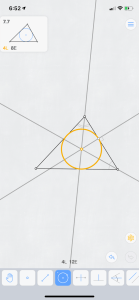
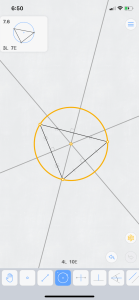
After playing and succeeding in the first handful of levels, I decided to peek at the rest of the levels and was pleasantly surprised to find later levels that tied directly to what I had been teaching in class about points of concurrency (incenter and circumcenter). I realized that the game could be incorporated, in bits and pieces, into the curriculum. I would not see it a lesson into itself, but as a challenge or a way to have students practice and recognize some of the features of this concept, in conjunction with the lesson.

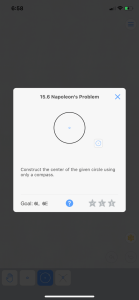
Finally, I came across a level called “Napoleon’s Problem”. I’d not heard of this problem before, but after investigating it (thanks Wikipedia), I saw this as a challenge problem that could be used to push students to investigate further into areas that might not be covered in any class. The problem is simply stated – find the center of a circle using only a compass. The simplicity of the problem invites all kinds of efforts to find a solution (efforts that may be frustrating, but are educational even in struggle). Students may try to find the solution on-line, but even in that process, they would be learning and investigating the use of the compass and the logic with which it is employed to solve the problem.

So my opinion remains that this is not the next x-box, but for a class supplement and source of challenge, I could see using it.

Euclidea

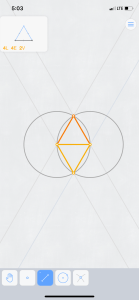
In teaching 10th grade algebra and geometry students, I am always looking for creative math games and activities that are not seemingly designed for the middle school ages (and younger). I finally came across an app called Euclidea, which is essentially a “game” to practice Euclidean geometric constructions. The game is multi-level, starting with the most basic constructions (like creating an equilateral triangle) and building towards more and more complicated constructions (like inscribing a circle in a square).

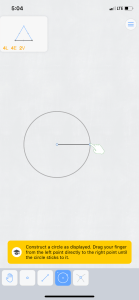
The game is a bit short on instructions, so the learning curve on each new level can be challenging as the constructions become more complicated. But once you learn how the game is manipulated using the different types of drawing tools, it is simple enough to play. The objective of each level is to create a geometric figure in the least number of moves possible. There are two types of moves that are independently counted (E and L-type) and each type of move has its own goal. Complex moves (like using a segment bisector) count as a single “L-type” move (you used it once), but, in recognition that it takes three “sub-moves” to actually produce that segment bisector using a compass and straightedge, it counts as 3 “E-type” moves. A level is completed by actually making the construction, but a goal is to make the construction in a set number of L-type or E-type moves.

I have spent an hour or so in the game. It was quick to figure out how to manipulate the tools, but I lost interest pretty quickly – largely because I struggled to figure out some of the constructions and there were no helpful hints available – (actually the hints were pretty obscure). I think it would be a tough game to play for any extended period of time, but definitely a fun mental challenge to tackle from time to time. If I had a reason to tackle a particular construction (for example, in relation to a lesson), my interest would be piqued further.

For this reason, I think the game would work well as part of a geometry curriculum – particularly one that emphasizes Euclid’s constructions. I don’t think a student would pick the game up on their own (unless they were strongly interested in Euclid’s methods). It requires a fair amount of intentional thought to play the game “successfully” but the reward is in seeing the sophisticated geometric figures that can be built using nothing more than lines and circles in a logical and strategic order. If a player is not intrinsically or extrinsically motivated to hit the goals and achieve the construction in a minimal number of moves, she may miss some of the benefits of the game by throwing in more and more moves hoping to hit on the solution eventually.

I wish there were more opportunities to guide the player (with hints, etc.) since some of the levels can be quite challenging. It is not easy to skip over levels that can’t be completed – unless, like me, you pay the $.99 to unlock everything. The game can be quite frustrating if you cannot figure out how to make the construction. It is not a drill and practice game, but it is not a sandbox game or a choose your own adventure game. There is a defined construction to make in each level and no real benefit in trying to be creative outside of that goal. Honestly, there are other programs (like Geogebra) that better facilitate being “creative” using geometric shapes.

I could envision the game being used as a challenge activity within the classroom. If a version having all of the levels open is accessible, then students can be given a specific construction to work on (in connection with the class topic) and challenged to compete for the most efficient construction. It could also be used as a demonstration tool by the teacher.

The game will not replace x-box anytime soon, but as a tool in the classroom – I’d consider it.